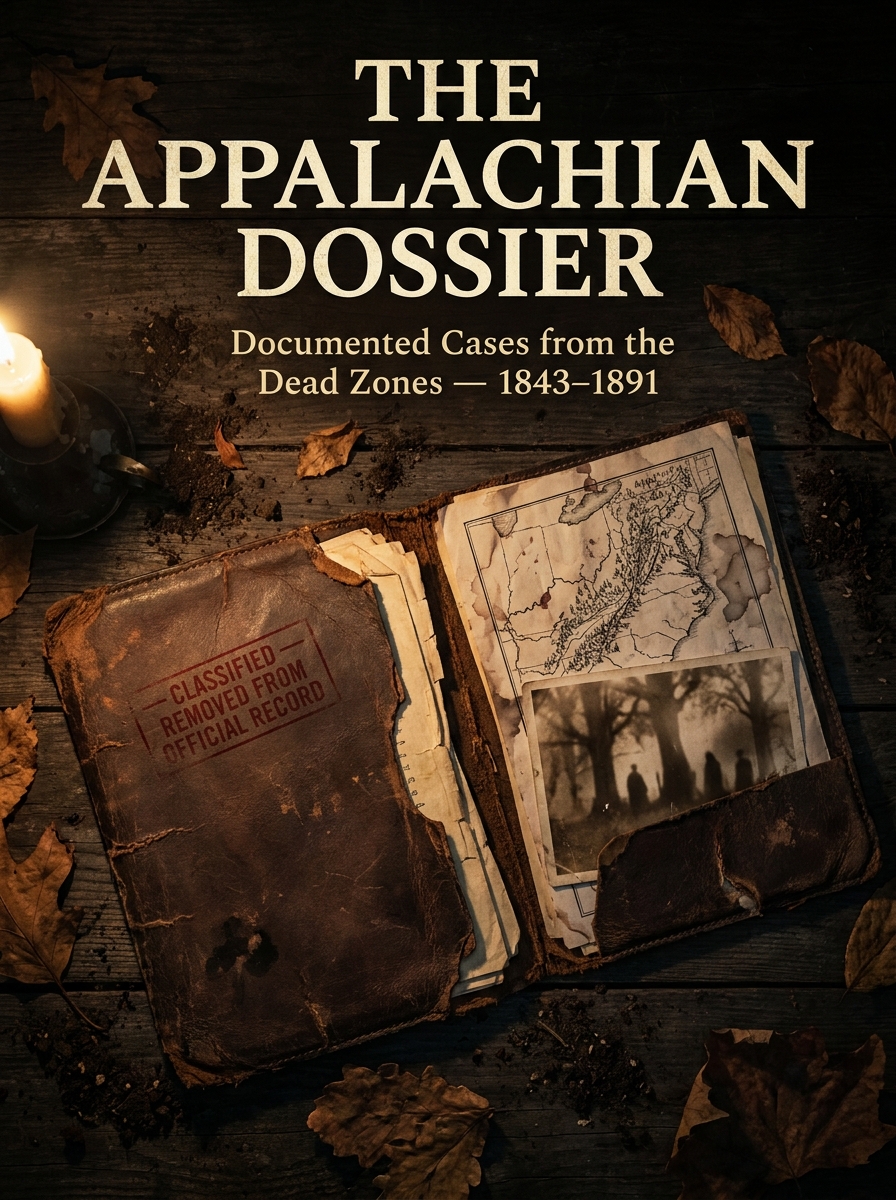
The Appalachian Dossier compiles classified field reports, private diaries, and forensic depositions from seven locations deliberately erased from official American records between 1843 and 1891.
Between 1843 and 1891, seven locations across the Appalachian interior became the subjects of field reports, private correspondence, and forensic depositions that never entered public record. Seven cases. Seven sites. The persons involved — trappers, surveyors, census workers, expedition members, and entire townships — share one documented fact: none provided follow-up accounts.
The Appalachian Dossier gathers these materials in their original documentary format. Field reports appear as field reports. Diary entries appear as diary entries. Depositions retain their original testimony structure. The compiler's notes are minimal. The sources are allowed to speak without editorial intervention.
What the documents describe ranges from the logistically inexplicable to the categorically outside human record-keeping frameworks. The dossier does not resolve these questions. It documents them.
Every document in this dossier was written by someone who did not survive to be asked about it.
"A trapper's cabin. Forty-one names in a journal. No remains."
"A town of 214 people. Gone without departure."
"A cave. A diary that ends mid-sentence. Two men who became something else."
"Eight-foot figures. No sound. Three surveyors unaccounted for."
"One man entered the chamber. A different man came back."
"Eleven workers entered the north bank. The ground never filled up."
"34 residents. All of them still living in 1831."
The Appalachian Dossier is a work of narrative nonfiction written entirely in documentary format — field reports, diary entries, forensic depositions, internal correspondence. The cases, locations, and individuals are fictional, but the format is not. Every document is written to read as a primary source, with the internal logic and linguistic register of its period. There is no narrator telling you what to think. The records speak for themselves.
You receive one PDF file — instant download, delivered via Hotmart. The dossier includes all 7 case files, 21 supporting documents, the epilogue, and both bonus items (the Dead Zones Chronology and the Reading Guide). No subscription. No waiting. No physical shipping. The file is yours permanently.
Any device that opens PDF files — which is all of them. Desktop, tablet, phone. The dossier is formatted for both screen reading and print. It was designed to be read as a physical document on screen, so the layout holds at any size.
The dossier does not rely on graphic violence or explicit horror. The unease comes from documentation — from the gaps in testimony, from language that is precise about things that should not be precisely described, from what the records do not say. If you are comfortable with true crime, wilderness disappearances, and 19th-century deposition language, you will be comfortable here. The cases are disturbing in proportion to how seriously you take them.
No — each case file is self-contained and can be read independently. The included Reading Guide suggests an optimal sequence based on thematic connections and cross-case references, but the dossier is structured to function as an archive: you enter where you choose. The Epilogue, however, is best read last.
Everything included in a single file — delivered instantly.
One-time payment · No subscription · Instant digital access
Access the Dossier NowPDF format · Delivered via Hotmart · Yours permanently